

How to Store Macarons: Filled, Unfilled, Fridge, and Freezer
Published · Updated
The best way to store macarons depends on whether the shells are filled and what is inside them. Empty shells mainly need protection from air, moisture, and breakage. Filled macarons must also follow the food-safety and storage needs of the filling.
Use an airtight container, keep perishable fillings at 4°C (40°F) or below, and let the shortest-lived ingredient determine the storage time. A balcony, terrace, garage, or car is not a safe substitute for a temperature-controlled refrigerator.

Macaron Storage at a Glance
| Type | Where to store | Practical home guideline |
|---|---|---|
| Unfilled shells | Airtight at cool room temperature | About 2–3 days for best texture |
| Unfilled shells | Airtight in the freezer | About 1 month for best quality |
| Filled with buttercream or ganache | Refrigerator at 4°C (40°F) or below | Usually 3–4 days; follow the filling recipe |
| Filled with curd, custard, cream cheese, or fresh dairy cream | Refrigerator | Use the recipe’s shorter limit; generally within 3–4 days |
| Filled with cut fresh fruit | Refrigerator | Best the same day; use promptly |
| Frozen filled macarons | Freezer at -18°C (0°F) or below | About 1 month for quality if the filling freezes well |
These are conservative home-kitchen guidelines, not commercial shelf-life validation. Recipe acidity, water activity, sugar concentration, dairy content, handling, and packaging all matter. When a filling recipe gives a shorter time, use that time.
The Most Important Rule: Store for the Filling
A baked macaron shell is relatively dry, but filling adds moisture and may add eggs, dairy, fresh fruit, or other perishable ingredients. The completed macaron is only as shelf-stable as its most perishable component.
- Low-moisture buttercream: often holds its texture well, but dairy or egg ingredients may still require refrigeration.
- Chocolate ganache: contains cream in many recipes and should not automatically be treated as shelf-stable.
- Curd or custard: refrigerate promptly and follow the recipe’s storage limit.
- Cream cheese, mascarpone, or whipped cream: keep continuously refrigerated.
- Fresh or cut fruit: adds water, softens shells quickly, and has the shortest quality window.
- Jam or caramel: shelf life varies with the exact formula; a commercial jar’s unopened date does not determine the life of a homemade filled macaron.
How to Store Unfilled Macaron Shells
Completely cool the shells before packing them. Warm shells release moisture inside a closed container, which can soften the surface and cause sticking.
- Choose a rigid airtight container so the shells cannot be crushed.
- Arrange shells in a single layer or separate layers with parchment paper.
- Keep the container away from heat, sunlight, steam, and strong odors.
- At a cool, dry room temperature, use the shells within about 2–3 days for the best texture.
- For longer storage, freeze the shells instead of leaving them in the refrigerator, where humidity and odors can affect quality.
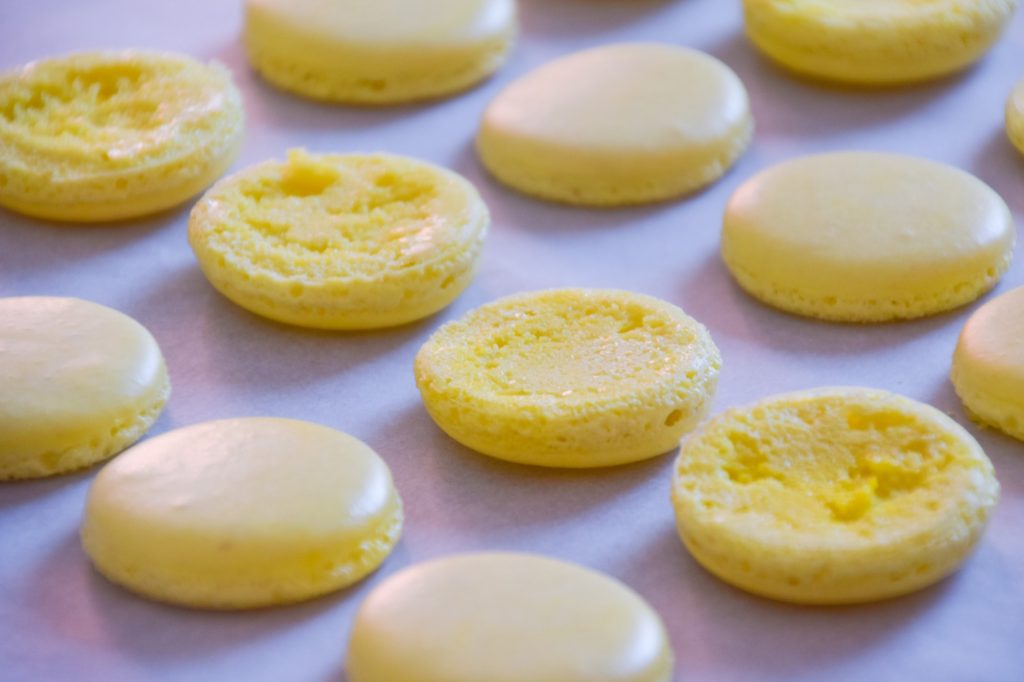
How to Freeze Empty Macaron Shells
- Cool the shells completely.
- Layer them in a rigid airtight freezer-safe container with parchment between layers.
- Label the container with the flavor and date.
- Freeze promptly and use within about 1 month for the best flavor and texture.
- Thaw the closed container at room temperature. Open it only after the shells have warmed so condensation forms on the container instead of the shells.
Freezing does not improve an underbaked or sticky shell. Make sure the bases and interiors are fully set before storage.
How to Store Filled Macarons
- Let the filling reach the consistency specified by its recipe before assembling.
- Place filled macarons in a clean, airtight container without squeezing them together.
- Refrigerate promptly if any component requires refrigeration.
- Allow 12–24 hours for maturation when the filling and recipe support it.
- Bring macarons to serving temperature in the closed container, then open it to reduce condensation.
- Discard macarons with mold, fermentation, off odors, leaking filling, or uncertain temperature history.
Buttercream-Filled Macarons
Buttercream is often a good macaron filling because it pipes cleanly and transfers moisture gradually. Its storage life still depends on the formula. American-style buttercream, Swiss meringue buttercream, French buttercream, and cream-cheese buttercream do not have identical handling needs.
For a conservative home guideline, refrigerate filled macarons and use them within 3–4 days unless the tested filling recipe gives a shorter time. Do not rely on the sugar alone to make a dairy- or egg-based buttercream safe at room temperature.
Ganache-Filled Macarons
Ganache generally freezes and matures well, but a cream-based ganache is still a perishable filling unless the formula has been professionally validated as shelf-stable. Refrigerate homemade ganache macarons and use them within about 3–4 days, or follow the shorter limit in the recipe.
If ganache looks split, smells sour, or has been left warm for an uncertain period, discard it rather than tasting it to decide.
Fresh-Fruit Macarons
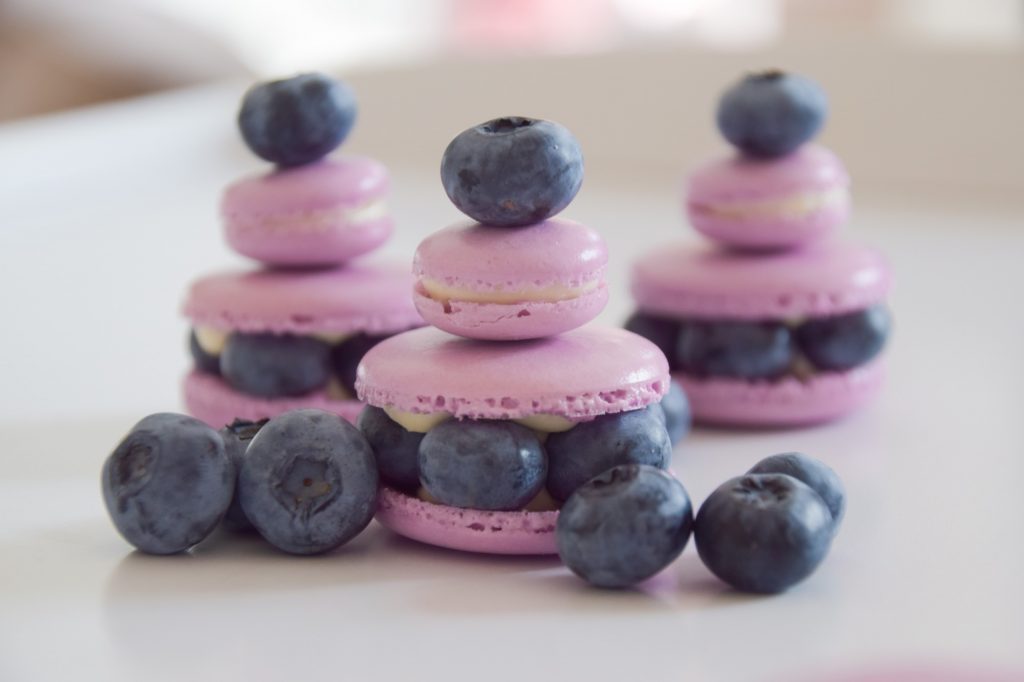
Fresh fruit provides the shortest quality window because juice migrates into the shells. Cut berries soften macarons faster than whole berries, and fresh-fruit pieces add a perishable food-safety concern.

- Keep fruit-filled macarons refrigerated until serving.
- Assemble cut-fruit macarons as close to serving as practical; the same day gives the best texture.
- Do not leave perishable fruit-and-cream fillings at room temperature for more than 2 hours, or 1 hour above 32°C (90°F).
- Transport them in an insulated cooler with ice packs, not loose in a car.
See the raspberry vanilla macarons and blueberry macarons for filling-specific assembly instructions.
Curd, Custard, Cream Cheese, and Whipped-Cream Fillings
These fillings require continuous refrigeration. Use pasteurized ingredients when the recipe calls for them, work cleanly, and follow the recipe’s shortest refrigerated-storage limit. A 3–4 day maximum is a general leftovers benchmark, not permission to extend a recipe that says to use the filling sooner.
The FDA recommends keeping the refrigerator at 4°C (40°F) or below and refrigerating perishable prepared food within 2 hours. The USDA leftovers guidance uses 3–4 refrigerated days as a general limit.
Can You Freeze Filled Macarons?
Yes, when the filling freezes well. Buttercream, many ganaches, and firm caramel usually handle freezing better than fresh fruit, whipped cream, or fillings that separate after thawing.
- Chill the assembled macarons first so the filling is firm.
- Pack them in a rigid airtight freezer container with parchment between layers.
- Freeze for about 1 month for best quality.
- Thaw overnight in the refrigerator while the container remains closed.
- Bring to serving temperature in the closed container before opening.
Test one or two macarons before freezing an important order. A technically safe filling can still become grainy, watery, or soft after thawing.
How Long Can Macarons Sit at Room Temperature?
Unfilled shells or macarons made with a genuinely shelf-stable filling may tolerate a cool room for serving, but heat and humidity quickly damage texture. Perishable fillings must follow the two-hour rule: refrigerate within 2 hours, or within 1 hour when the surrounding temperature is above 32°C (90°F).
For a dessert table, put out a small tray and replenish it from the refrigerator. Keep the rest cold in an airtight container.
Packing and Transporting Macarons
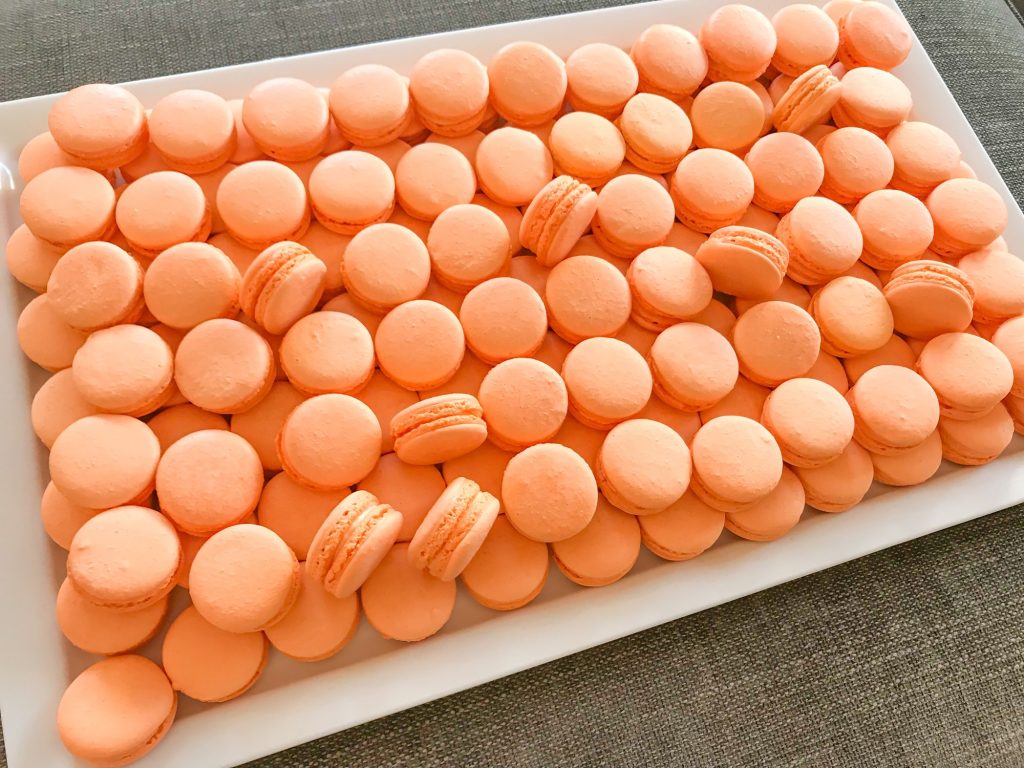
- Use a rigid container with a tight lid and food-safe dividers if available.
- Place macarons upright or in snug rows so they cannot slide and crack.
- Transport perishable macarons in an insulated cooler with frozen gel packs.
- Keep the cooler out of direct sun and minimize how often it is opened.
- Do not store macarons in a parked car, even in cool-looking weather; vehicle temperatures change quickly.
Frequently Asked Questions
Should macarons be refrigerated?
Filled macarons should be refrigerated whenever the filling contains ingredients that require refrigeration. Empty shells can be kept airtight at cool room temperature for a few days or frozen for longer storage.
Can macarons stay in the refrigerator for one week?
Do not use one week as a blanket rule. Some low-moisture formulas may retain quality that long, but homemade fillings containing dairy, egg, custard, or fruit often need a shorter limit. Follow the filling recipe and use 3–4 days as a conservative general maximum when no shorter instruction applies.
How do you keep macarons from getting soggy?
Use a filling with controlled moisture, avoid overfilling, store airtight, and do not assemble fresh-fruit macarons too early. Sogginess is moisture migration; extra refrigeration time does not reverse it.
How should frozen macarons be thawed?
Thaw them in a closed container—first in the refrigerator for filled macarons, then at room temperature. Keeping the lid closed reduces condensation on the shells.
Can I refrigerate macarons on a balcony or in a car?
No. Those locations do not maintain a verified temperature of 4°C (40°F) or below and can expose food to sunlight, pests, contamination, and rapid temperature changes.
Storage Checklist
- Shells are completely cool before packing.
- The container is clean, rigid, and airtight.
- Perishable fillings stay at 4°C (40°F) or below.
- The shortest-lived ingredient controls the use-by time.
- Room-temperature serving stays within the two-hour limit.
- Frozen macarons thaw in the closed container.
- Anything with uncertain temperature history is discarded.
Enjoy your macarons!
Belli xx