

What Is Macaronage? How to Fold Macaron Batter Correctly
Published · Updated
Macaronage is the controlled folding and deflating step that turns meringue plus almond flour and powdered sugar into pipeable macaron batter. The goal is not to preserve every air bubble and not to knock all the air out. You are creating a smooth batter that flows in a slow ribbon, settles after piping, and still has enough structure to rise in the oven.
Correct macaronage helps produce level tops, defined feet, and evenly shaped shells. It cannot compensate for weak meringue, inaccurate weighing, or an incorrect oven temperature, but it is one of the most important variables you control by hand.
Macaronage at a Glance
| Stage | What the batter looks like | What to do |
|---|---|---|
| Just combined | Thick, rough, and holds sharp ridges | Keep folding and scraping the bowl |
| Almost ready | Glossy and moving, but the ribbon breaks quickly | Check after every few folds |
| Ready | Flows in a slow, continuous ribbon and settles gradually | Stop folding and pipe |
| Overmixed | Very loose, fast-flowing, and spreads immediately | Pipe promptly; it cannot be thickened reliably |
Why Macaronage Matters
Freshly whipped meringue contains more air than the finished batter needs. Folding distributes the dry ingredients and removes some of that air in a controlled way. If too much air remains, piped shells may keep pointed tops, bake unevenly, or crack. If too much air is removed, the batter may spread into thin shells with weak or absent feet.
Macaronage is only one part of the system. Shells can still be hollow, cracked, sticky, or lopsided because of meringue quality, humidity, resting, piping, baking surface, oven heat, or bake time. Use the batter tests below as endpoint guides rather than a guarantee of a perfect batch.
Before You Begin Folding
- Weigh every ingredient. Macarons are not a good place for volume estimates.
- Prepare a stable meringue. It should be glossy and hold the peak required by your recipe.
- Break up almond-flour lumps. Sift or process the dry mixture as your recipe directs, discarding unusually coarse pieces.
- Use a flexible silicone spatula and a wide bowl. You need to reach the bottom and sides without chasing batter around a narrow container.
- Prepare the piping bag and trays first. Once the batter is ready, pipe it without an unnecessary delay.
For a complete formula, use my Italian-method macaron recipe. This guide focuses specifically on recognizing and controlling the folding stage.
How to Do Macaronage Step by Step
- Add the meringue to the almond mixture in the additions specified by your recipe. The first addition can be mixed a little more firmly to loosen a dense almond paste.
- With the flat side of the spatula, cut through the center, sweep along the bottom, and lift the batter up and over itself.
- Rotate the bowl as you work so no dry pockets remain on the bottom or sides.
- Once the mixture is uniform, begin checking consistency frequently. Use deliberate strokes; speed is less important than control.
- Lift the spatula and observe how the batter falls. Stop as soon as it reaches the slow-ribbon stage described below.
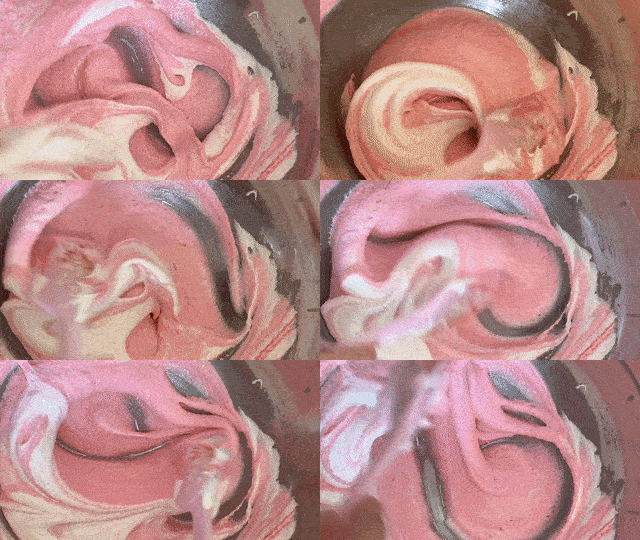
Some bakers press a portion of batter against the side of the bowl to remove air, then gather and fold it back into the mixture. That technique can work, especially with a very firm Italian meringue, but use light pressure and check often. Aggressive smearing can take the batter past the correct point quickly.
How to Know When Macaron Batter Is Ready
1. The Ribbon Test
Lift a full spatula of batter about 6 inches (15 cm) above the bowl. Ready batter should fall in a continuous, moderately thick ribbon instead of dropping in heavy clumps or running like liquid. The ribbon should remain visible briefly, then slowly blend back into the surface.
2. The Figure-Eight Test
Try drawing one figure eight with the falling ribbon without it snapping. This is a useful secondary check, not a rule by itself: an overmixed batter can also draw an easy figure eight. Pay attention to the ribbon’s thickness and how quickly it disappears into the bowl.

3. The Surface-Settling Test
Let the batter sit undisturbed in the bowl for about 20 to 30 seconds after a ribbon falls. The edges of the ribbon should soften and mostly merge into the surface, but the whole bowl should not become flat immediately.
4. A Test Dollop
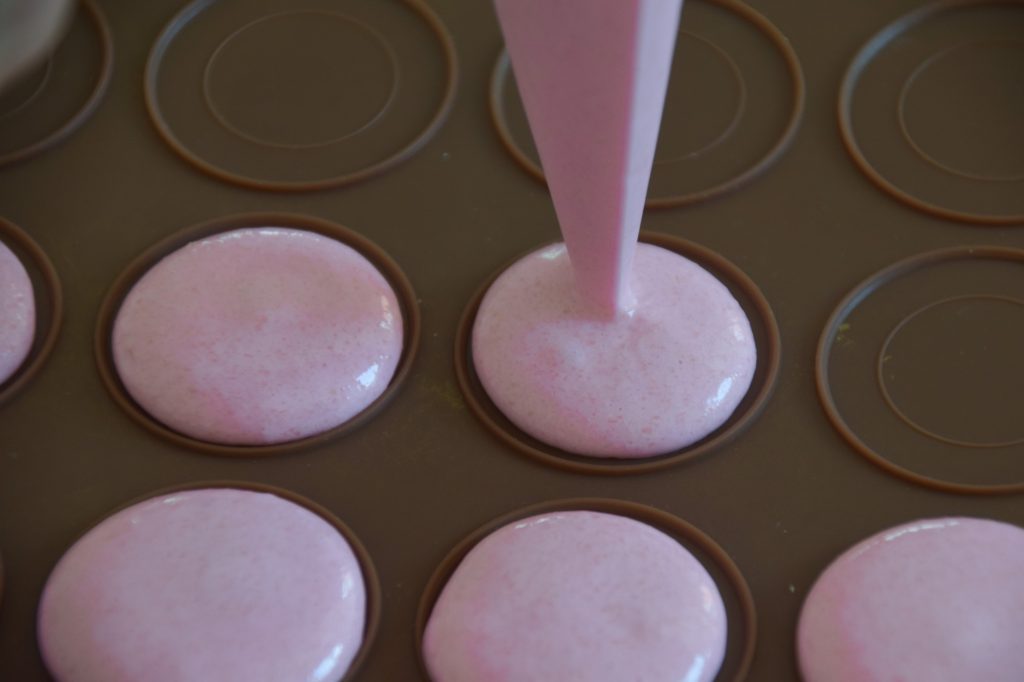
Place a teaspoon-sized dollop on the prepared mat or parchment. A small point should soften within roughly 30 to 60 seconds. If it stays sharply pointed, fold a few more times. If it spreads rapidly and keeps widening, the batter has gone too far.
Undermixed vs. Overmixed Macaron Batter
| Batter | Before baking | Possible baked result |
|---|---|---|
| Undermixed | Stiff, lumpy, ribbon breaks, points remain | Uneven tops, peaks, cracking, lopsided shells |
| Correct | Smooth slow ribbon, controlled spread | Even rounds with a better chance of stable feet |
| Overmixed | Thin, fast ribbon, spreads immediately | Flat or oversized shells, weak feet, fragile tops |
There is no reliable ingredient you can add to reverse overmixed batter. Adding almond flour changes the formula and usually creates new problems. Pipe the batch promptly, learn from how it bakes, and stop earlier next time.
How Many Times Should You Fold Macaron Batter?
There is no correct fold count. Bowl shape, batch size, meringue strength, flour fineness, coloring, and the way each person folds all change the number. A recipe that gives a count can offer a rough checkpoint, but the batter’s behavior must determine the endpoint.
The same applies to time. Macaronage may take a couple of minutes, but a timer cannot tell you when the batter is ready. When you are close, pause after every two or three folds and repeat the ribbon test.
Should Macaronage Be Slow?
Macaronage should be controlled, not necessarily extremely slow. Hesitant little strokes can take a long time and still mix unevenly. Use complete strokes that reach the bottom of the bowl, then slow down only as you approach the endpoint. The final few folds are where the consistency can change quickly.
Can You Do Macaronage With a Mixer?
A mixer can be used in production kitchens with a tested formula, known batch size, and carefully controlled paddle speed. For home bakers, folding by hand is the safer recommendation. A mixer can move from thick to overmixed before you recognize the change, and different machines do not have comparable low-speed settings.
Do not use a mixer attachment merely because it has a flexible edge. Hand mixing gives you direct feedback and lets you stop immediately. Save the whisk attachment for building the meringue.
Does Macaronage Change by Macaron Method?
- French method: the meringue can be more delicate, so combine evenly without crushing it early. The batter may reach the endpoint quickly.
- Italian method: the meringue is usually firmer and may tolerate more deliberate deflation. The first addition is often used to loosen the almond paste.
- Swiss method: the heated meringue can be stable, but the same slow-ribbon endpoint still applies.
The visual endpoint matters more than copying the exact motion from a baker using a different recipe. Follow the mixing sequence in your chosen formula, then use the same readiness tests each time.
Common Macaronage Mistakes
- Continuing to fold only because a recipe lists a specific number.
- Checking only whether the batter can draw a figure eight.
- Leaving dry mixture on the bottom or sides of the bowl.
- Adding color late and overmixing while trying to distribute it.
- Trying to repair overmixed batter with extra almond flour or powdered sugar.
- Piping one tray, then leaving the remaining batter in the bag for a long time.
Use concentrated gel or powder color and add it at the stage recommended by your recipe. My guide to the best food coloring for macarons explains which types add the least moisture.
Frequently Asked Questions
What Does Properly Mixed Macaron Batter Feel Like?
It feels cohesive and glossy, with some resistance on the spatula. It should flow, but it should not feel watery or pour as quickly as pancake batter.
Why Does My Batter Pass the Figure-Eight Test but Spread Too Much?
The figure-eight test confirms continuity, not thickness. If the ribbon disappears instantly or a test dollop keeps expanding, the batter is already overmixed.
Can I Stop and Resume Macaronage Later?
Short pauses for checking are helpful, but do not leave partially mixed batter sitting for an extended period. Finish the batter, transfer it to the bag, and pipe the trays efficiently.
Does Humidity Change the Number of Folds?
Humidity can affect drying and the finished shell, while ingredient moisture can affect batter behavior. Do not add folds simply because the day is humid; judge the ribbon and spread directly.
Is Macaronage the Only Cause of Hollow Macarons?
No. Hollow shells can also come from meringue, oven temperature, bake time, resting, and cooling. Use my macaron troubleshooting guide to evaluate the complete process.
Final Macaronage Checklist
- No dry pockets remain.
- The batter is glossy and cohesive.
- It falls in a slow, continuous ribbon.
- The ribbon settles gradually rather than instantly.
- A test dollop softens without spreading excessively.
- You stop as soon as all of those signs agree.
Macaronage becomes easier when you use the same recipe, bowl, spatula, and batch size repeatedly. Record what the batter looked like and how the shells baked, then adjust one variable at a time.
Enjoy your macarons!
Belli xx